
Trace Former Washington County Property Owners
Former owners come into view one recorded transfer at a time. The method is simple: treat the current deed as the end of the chain. Washington County supports this work through a paid Tapestry grantor-grantee search online. Older deed books, alphabetical and numerical indexes, probate files, and plats extend the hunt into archival collections. Coverage is uneven, though. Courthouse fires in 1870 and 1872 destroyed early title, deed, school-land, and Treasurer records. Some links in the chain simply cannot be rebuilt.
| Source | Years It Covers | Where Held | What It Shows |
|---|---|---|---|
| Fidlar Tapestry | Modern remote coverage; exact start year not verified | Register of Deeds portal | Grantor, grantee, dates, descriptions, types, and images |
| Deed indexes and books | Index series includes 1860-1936 | Register of Deeds and KSHS | Earlier parties, book/page references, and instruments |
| Historic atlases | 1882 and 1906 | Kansas Memory | Township plats, place clues, and compiled landowner names |
| Probate and court records | Historic series vary | KSHS and District Court | Estate, guardian, partition, and court-directed transfers |
Start with Tapestry for a modern chain of title. Its book and page numbers, plus the party names, become your entry points into the older indexes. For nineteenth- and early-twentieth-century digging, the KSHS Washington County series catalog lists the relevant holdings, and confirming access before a trip saves disappointment.
Walk the Washington County Deed Chain Backward
The backward chain has one rule. Each current grantee becomes the search key for the acquisition deed that came before it, and recording details plus the legal description get written down at every single step.
- Identify the present parcel and retrieve the current owner's acquisition deed, with that owner searched as grantee.
- Copy the grantor, recording date, instrument type, book/page or instrument reference, and complete description.
- Search that grantor as an earlier grantee and retrieve the instrument by which the prior owner acquired the same tract.
- Repeat until remote coverage ends, then continue through alphabetical or numerical deed indexes and deed books.
- Record a gap honestly and test probate, court, atlas, and newspaper sources rather than inventing a transfer.
- Grantor and grantee
- The parties conveying and receiving the stated interest.
- Chain of title
- The ordered series of instruments affecting ownership of the same tract.
- Reverse index
- An index arrangement used to find a party in the grantee role while moving backward.
- Warranty and quitclaim deeds
- Different conveyance forms; neither label alone resolves every title question.
Search Tapestry Without Losing the Tract
The county document-search page returns grantor, grantee, recording date, legal description, subdivision, parcel ID, and document type. Tapestry charges $6.95 for a search of the index with images included. Printed pages cost $1 each. The county publishes no confirmed start year for its online coverage. Ask the Register before assuming a cutoff date.
Name variants are worth trying. Just remember that the legal description has to stay consistent. A similarly named person elsewhere in the county does not join the chain merely because the dates overlap. Telephone, mail, and counter service are available through the Register at 214 C Street, Washington, KS 66968, 785-325-2286, weekdays 8:00 a.m. to 5:00 p.m.
Account for the 1870 and 1872 Courthouse Fires
Washington County's first courthouse dated to 1867. Fires in 1870 and then 1872 destroyed school-land, title, deed, and Treasurer records. That loss is real, and it complicates some early former-owner research. It also cuts both ways. A missing book entry never proves that a transfer failed to happen.
Research the gap. Note the fire dates in the chain memo, distinguish a missing source from a missing transaction, and triangulate surviving records.
Start from the latest surviving deed. Work backward from there, testing KSHS deed indexes, probate journals, district-court dockets, atlases, plats, and newspaper legal notices along the way. Later instruments sometimes recite an earlier grantor, patent, estate, or description, and those recitals can quietly reconnect a broken chain.
Use the 1882 and 1906 Atlases as Name Finders
Two digitized atlases on Kansas Memory work well as name finders. The 1882 Washington County atlas holds 90 images, and the 1906 atlas holds 81. Each pairs township and town plats with directories and portraits. Historic place tags help too. Together they can point to a former owner of record or pin down a tract whose modern address simply did not exist yet.
The atlas viewer itself gives a visual way into the collection.
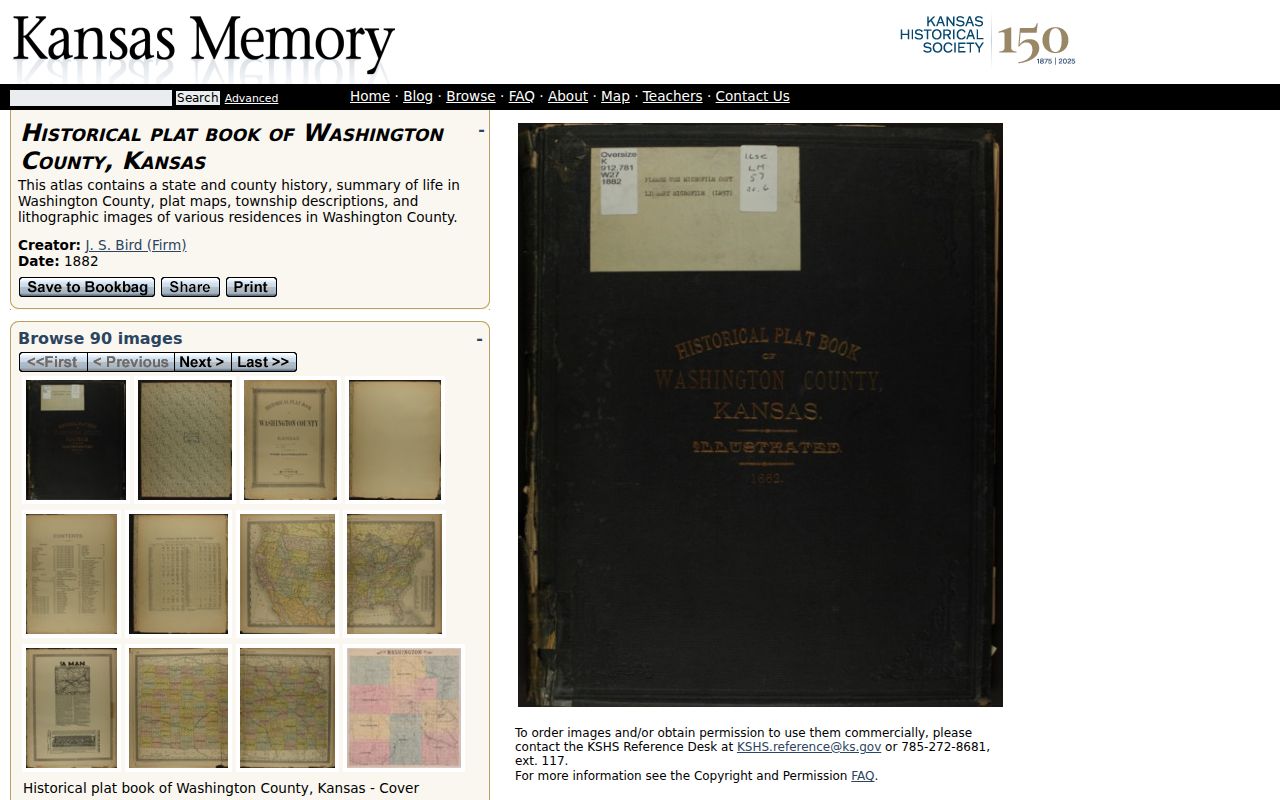
An atlas name is map evidence, not a deed. Take that name to the deed index. Demand a matching legal description before accepting it. For Linn, also try Summit, its railroad-era name, and note the 1883 plat date. Clues like these bridge naming changes well, but only the recorded conveyance settles ownership.
Bridge a Washington County Estate Transfer
A tidy seller-to-buyer sequence can stall when an owner dies. The deed record may hold affidavits and survivorship instruments. It may also hold executor deeds, administrator deeds, or deeds signed by a personal representative. Check Kansas CaseSearch under the decedent or estate name. Search the KSHS probate materials the same way. Those files can reveal the authority behind the next transfer.
Archival holdings include probate proceedings, administrator accounts, guardians' real-estate mortgages and sales, and court dockets. Kansas death records are not open public indexes. Certified access requires a qualifying relationship, representative status, or a direct property-right interest. Lean on deed and probate records first.
Turn a Legal Notice into a Deed-Index Lead
Old newspapers can surface a sheriff's sale, tax sale, probate filing, or administrator action. Road cases, plats, and annexations can appear there too. Search by city, county, title, and date range. Then pull a party name, date, court case, or instrument clue out of the story. Carry it to the Register, Treasurer, Clerk, or court.
A newspaper report never establishes ownership by itself. It might describe a sale that never closed. It might summarize a court action without the final order. The real goal is the official record that followed the headline. That distinction matters most around a foreclosure or an estate. That is where former owners are often reconstructed.
How Far Back Washington County Ownership Can Go
The Register's history reaches back to the county's earliest recordkeeping. KSHS catalogs deed-index material beginning in 1860. Survival and online availability are separate questions, though. The county publishes no confirmed modern Tapestry cutoff year, so ask what is searchable remotely, what sits at the courthouse, and what survives only on microfilm or in archival books.
Federal land patents can pin down the very first transfer from the government. After that, county deeds carry the private chain forward. The fires may block a continuous run. Build a timeline with columns for date, grantor to grantee, deed type, book and page, description, and confidence, and leave an honest gap wherever evidence is missing.
Lawful use. Former-owner records support house history, estate research, and purchase diligence. Never use a historic chain to track, harass, intimidate, or harm a living person.
This workflow rebuilds time depth; it is not a title opinion. For a present-day check, use current property owner. For a single deed and copy procedure, use Washington County deed records.